
Re-Discovered Art
Previously unknown works by Eric Pape
May 2024
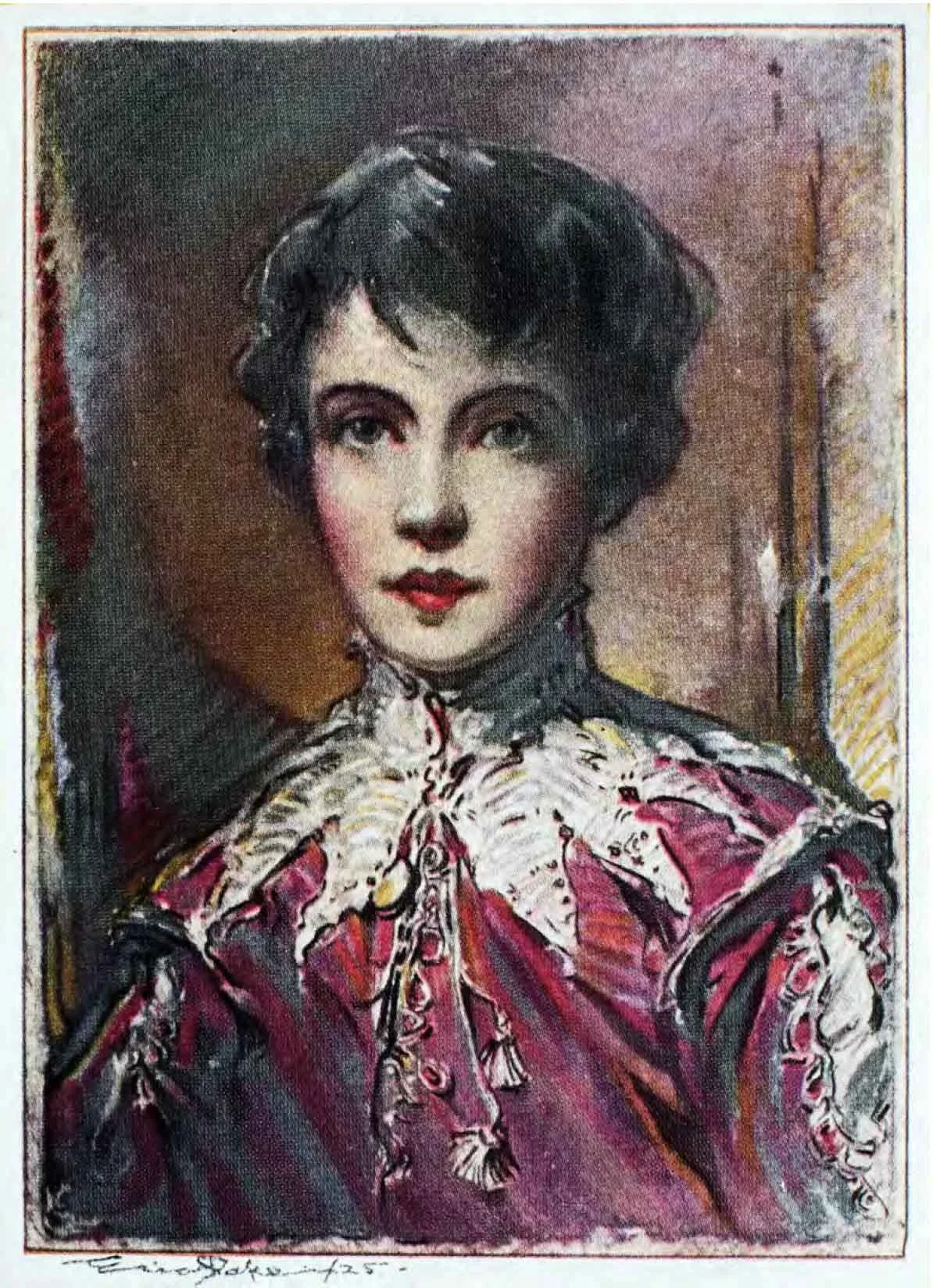
Each year I encounter several novel (to me) artworks by Eric Pape and discover previously unknown history related to others. This month’s entry in this category is a new drawing in my collection discovered at a New England estate sale in 2024. The lovely portrait of a young lad in Elizabethan costume was used as the dustjacket illustration and frontispiece for "A Little Captive Lad" by Beulah Marie Dix, 1922, "a story of a young boy among the Roundheads and Cavaliers". The drawing is apparently done in pen and ink with watercolor and pastel; Pape often used mixed media for his artworks. The drawing is only 8 x 11 inches on paper, just slightly larger than the print size of 5 x 8 inches. Pape throughout his career demonstrated impressive skill working in small formats. The image shown here is of the drawing including the signed paper mat attached to the front of the drawing. Pape often matted his works and his signature can be found either on the drawing itself or on the attached mat board.
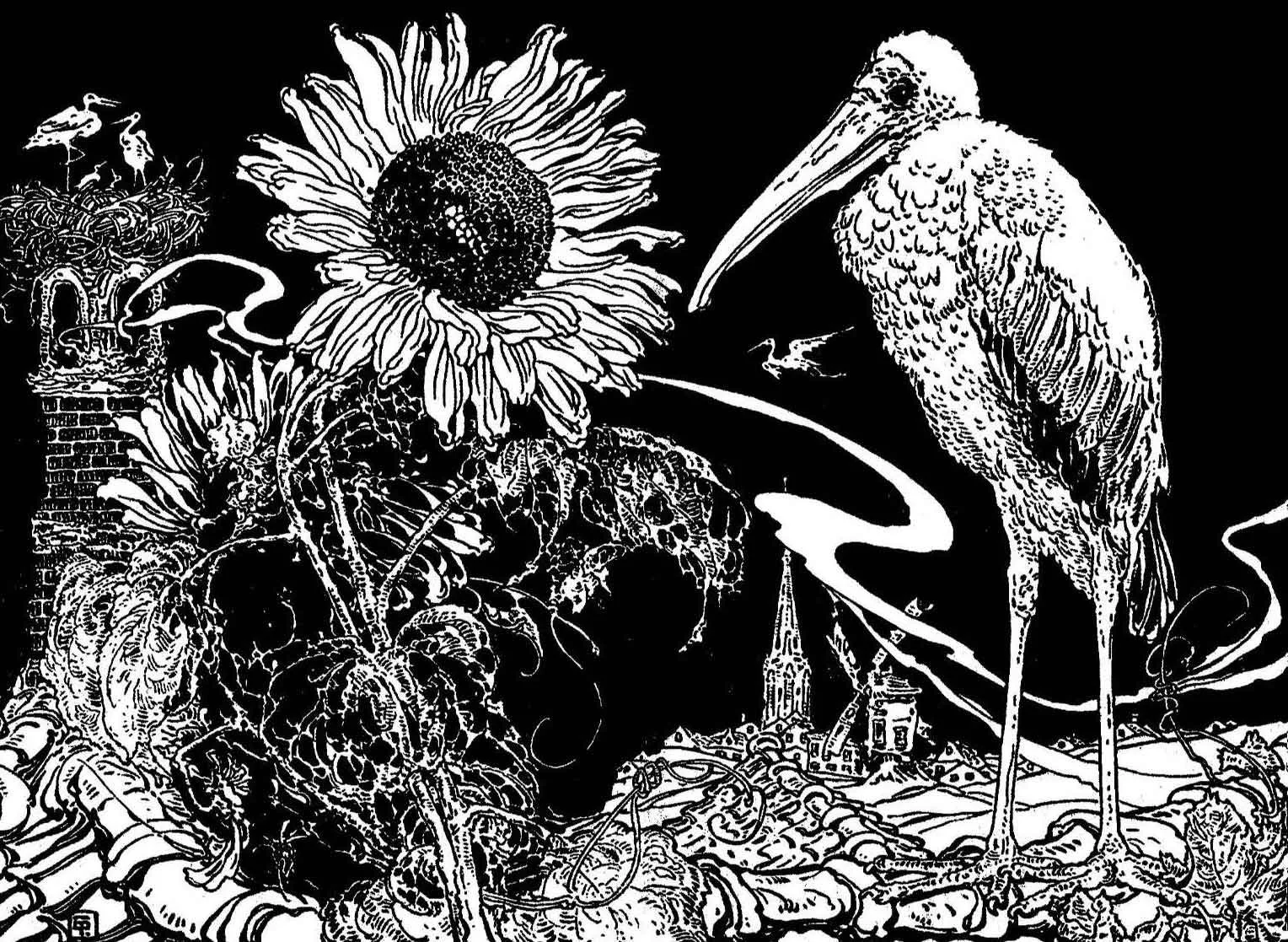
During the 1920s Eric Pape was commissioned to create art for many books for children like this one, including impressive efforts in pen and ink for "The Arabian Nights, Tales of Wonder and Magnificence" in 1923 and "Fairy Tales and Stories by Hans Christiam Andersen" in 1921. He also created the endpaper drawing for this book of a large stork and a sunflower in black and white, the stork figuring as a prominent charcter in the book named Flibbertigibberty. Pape had turned to rely on pastel drawings in the early 1900s when a serious fracture in his shoulder made holding the palette difficult, and he continued to create many notable pastel works for the rest of his life.
June 2024
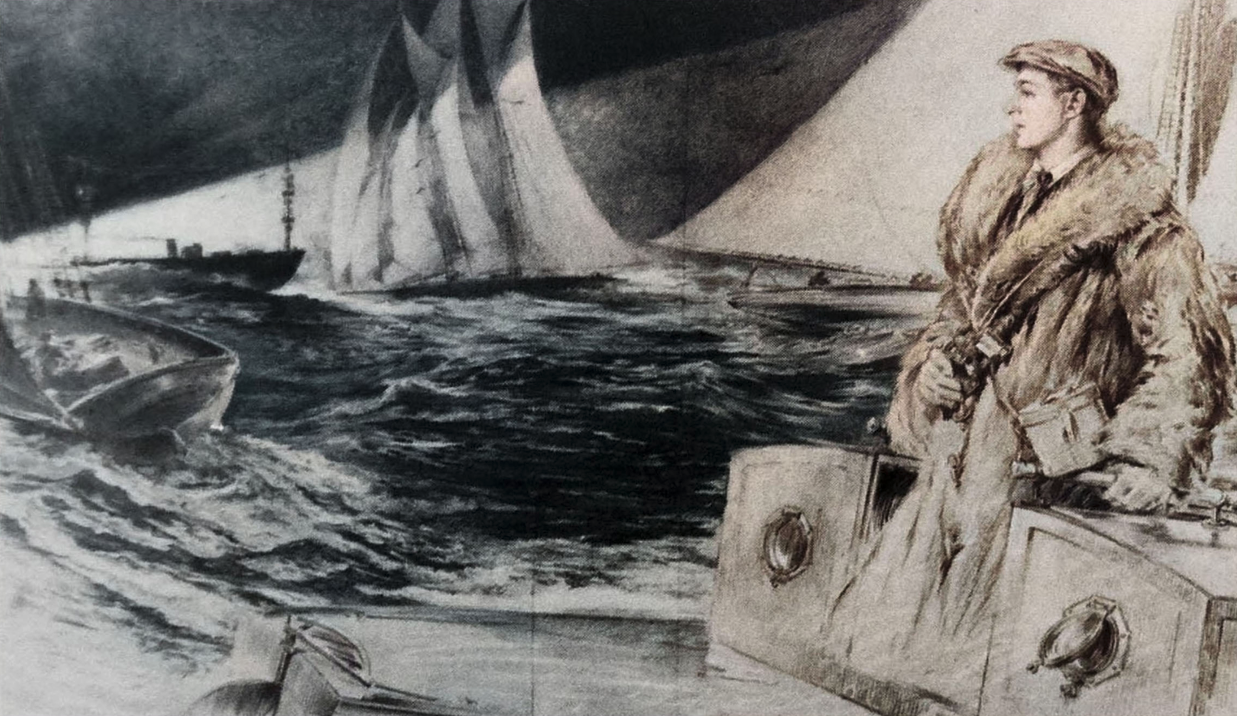
This month´s entry in this category is a drawing of inventor John Hays Hammond Jr. at sea on his yacht. The artwork was recovered from the "Locked Studio" of Eric Pape and sold at auction in 1991, 53 years after the artist´s death. The current owner of the artwork, my friend art collector James Moody, has kindly provided me with additional information about the artwork. The artwork was originally titled at time of sale "Onboard In High Seas/Portrait of John Hays Hammond Jr. Surveying the Fleet" signed and inscribed "Eric Pape, Gloucester, 1914", charcoal and whiting, watercolor and pastel on 3 sheets of paper mounted to a single panel, 25 x 40 inches, framed. Thanks to James Moody, we now know the correct title and description for the artwork is: 'John Hammond Jr. Observing His Ghost Ship Under Radio Control In the Inner Harbor, Illuminated From the Search Lights of the Castle, Terrifying the Returning Fishermen". The original artwork will hopefully be exhibited in the future at the Hammond Castle Museum in Gloucester so that the large, complex drawing, and the astonsihing events it records can be better appreciated by the public.
May 2025
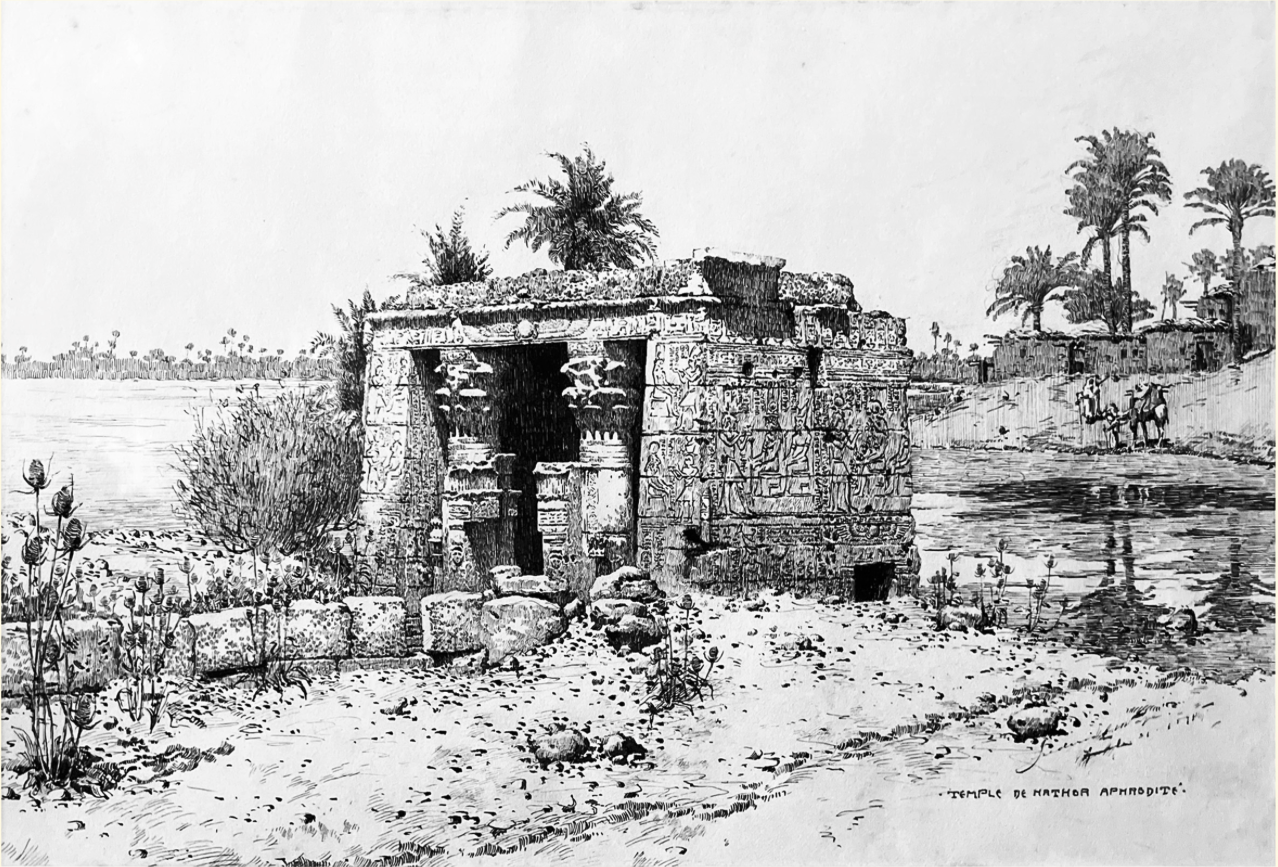
This month´s entry in this catagory is a new drawing in my collection surprisingly discovered in an antique shop in London, England! Although how it came to be in London is not known, Eric Pape's paint box used during his European student travels is inscribed with frequent vists to London and other English cities in 1889, 1892, 1893, 1896 and 1897. Pape was a member of the United Arts Club of London and a Fellow of the Royal Society of Arts. The beautiful, highly detailed pen and ink drawing of the small Ptolemaic Temple of Hathor Aphrodite on Philae Island is a lovely and typical example of Pape's meticulously composed and executed pen drawings; he was recognized as one of the most skilled artists of his time in this type of work. The drawing also provides a window into the past; the temple complex on Philae Island, near the First Cataract of the Nile in Upper Egypt contained an ancient collection of expansve temple complexes. These rapids and the surrounding areas were often flooded after construction of the Aswan Low Dam by the British in 1902. With the construction of the modern dam in Aswan a few kilometers upstream, these temples would have been permanently flooded; the temples were removed and reconstructed on higher ground. Thus the drawing by Eric Pape shows the Temple of Hathor Aphrodite in it's original location and state in the early 1890s, considerably different from the reconstructed modern complex.
August 2026
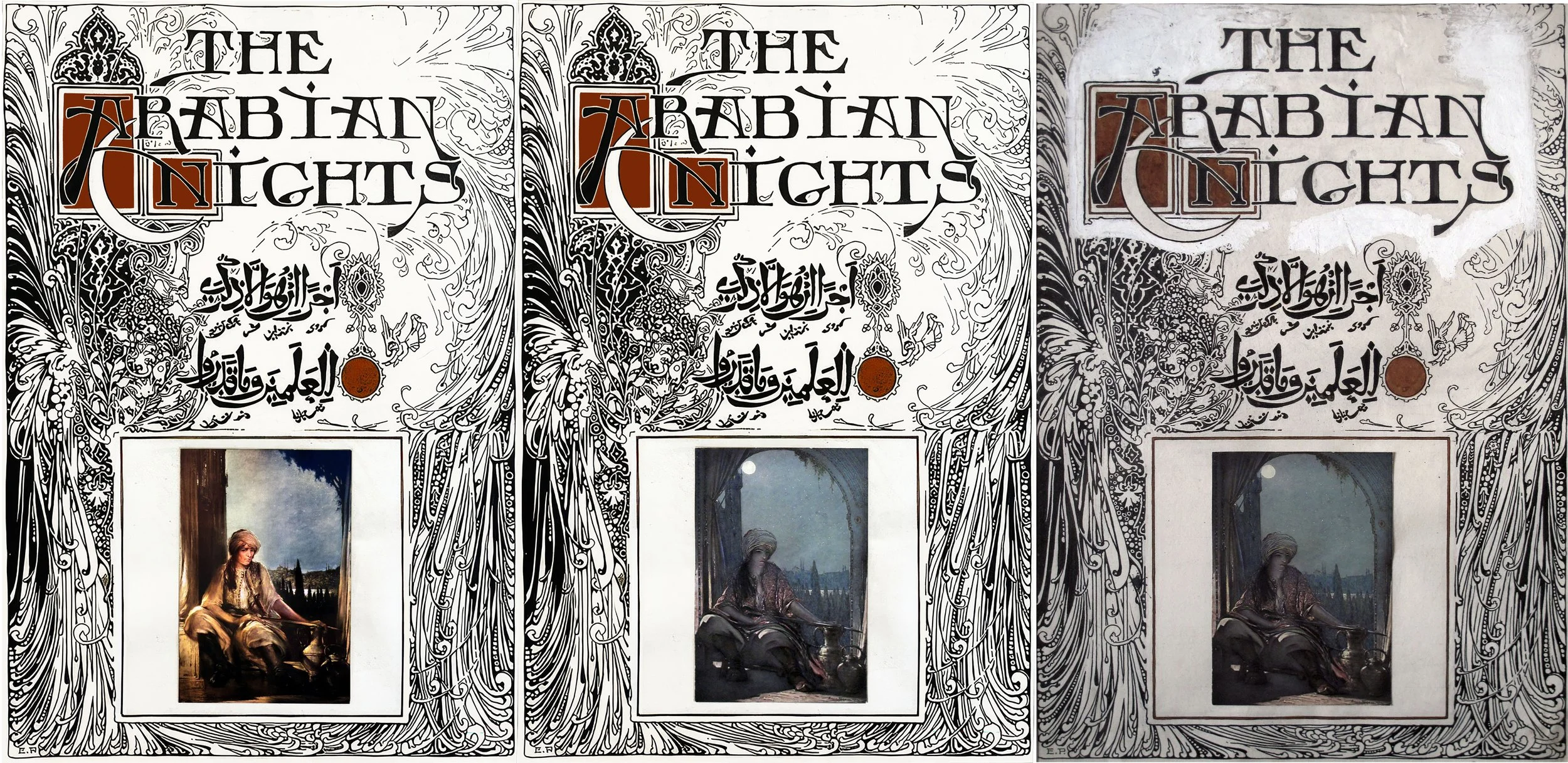
This month’s entry in this category is an elaborate pen and ink drawing intended to be the title page but never used for The Arabian Nights, Tales of Wonder and Magnificence, published by MacMillan in 1923, edited by Padraic Colum. While the book was filled with many dozens of Eric Pape's finest and most creative drawings in black and white, the publishers apparently decided to use just the book title letters of the page, but not the whole elaborate drawing, since when discovered in the "Locked Studio" of Pape he had blocked out much of the surrounding drawing from around the title letters with gouache. This part of the title page was used in the book. The current owner of the artwork, my friend prize winning photographer and art collector Bruce Haley, kindly loaned me this artwork, and 80 others by Eric Pape from his extensive collection, for display at the recent "Eric Pape: Fantasy Illustrations" exhibition at Hammond Castle Museum in Gloucester, Massachusetts. In preparation for the exhibition, all of Bruce Haley's artworks were planned to be cleaned and restored for the first time since they were created in 1923 and framed for museum display. Unfortunately, time limitations for this massive project meant this artwork did not undergo conservation efforts prior to the exhibition. Post exhibition, the artwork was returned to my art conservator for this project, Earl Parker of Parker Art and Restoration and work was completed on it. Bruce had kindly allowed, at my request, the white gouache to be removed so the complete original drawing could be seen for the first time since it's creation. In the composite drawing shown, the artwork, as recovered from the "Locked Studio" of Eric Pape after his death, is shown on the right. In the center is the image of the cleaned artwork with the white gouache removed, showing the complete drawing by Eric Pape. To the left is a version of the image where the color frontispiece insert has been replaced with a print of the actual frontis artwork by Pape "The Sultan's Bodyguard" to show what the artwork would have looked like with it included. In the published MacMillan "Children's Classics" edition of the book a different and lower resolution image of Pape's painting was used as the frontispiece. Thus, some 100 years after it's creation, we can see what this artwork might have looked like in press had the publishers embraced the original artwork as envisioned by Eric Pape.